A wetter, stormier winter: what it means for your building’s gutters
In short
The Met Office says a strong El Niño makes a wetter, stormier late autumn and early winter more likely across the UK. Heavy, repeated rain is what overwhelms gutters that are already part-blocked with autumn leaves. For schools, housing blocks and offices, that means water getting into buildings, damp walls and slippery entrances. Clearing gutters and downpipes after leaf fall and before the worst of the weather is the simplest way to avoid it.
What is the forecast for this winter?
The Met Office expects a wetter, stormier late autumn and early winter than usual across the UK, linked to this year’s strong El Niño. That means more heavy rain landing on gutters that are already part-blocked with leaves.
Most likely
Warmer, wetter and stormier conditions across the UK in late autumn and early winter.
How likely
Around one and a half to two times the usual chance of a warm, wet autumn, in the Met Office’s 3-month outlook.
Still possible
Cold spells later in winter. El Niño is one of several drivers, so it shifts the odds rather than fixing the weather. Freezing is a second risk for any gutter still holding water.
What is El Niño, and why does it matter for UK buildings?
El Niño is a natural warming of the surface of the tropical Pacific Ocean that happens every few years and shifts weather patterns around the world. The Met Office links a strong El Niño to warmer, wetter and stormier conditions across the UK in late autumn and early winter.
As of November 2026, El Niño is still strong. The US National Oceanic and Atmospheric Administration (NOAA) gives a greater than 83% chance that it stays strong to very strong through January to March 2027. For buildings, that points to more heavy, repeated rain through the winter, which is what overwhelms gutters that are already part-blocked.
Source: NOAA Climate Prediction Center, El Niño/Southern Oscillation diagnostic discussion
Why does heavy rain cause problems with gutters?
Heavy rain causes problems when gutters are part-blocked: the water can’t drain away fast enough, so it overflows, backs up into the building, or sits in the gutter and freezes.
A gutter is sized to carry rain off a roof at a steady rate. Leaves, moss and silt narrow the channel and block the outlets and hoppers where water drops into the downpipe. In a downpour, the water has nowhere to go:
1
It spills over
Over the front edge and down the face of the building.
2
It backs up
Behind the gutter, into fascias, soffits and the top of the wall.
3
It sits there
Adding weight to the brackets and, in a freeze, turning to ice.
Autumn is when gutters fill fastest. Leaf fall peaks in October and November, just before the wettest part of the year.
What do blocked gutters cost a commercial building?
Blocked gutters lead to water getting in, damp and mould, slippery entrances, damage to the building and blocked drains. Each of these costs far more to put right than routine clearing.
| Problem | What happens | Who feels it |
|---|---|---|
| Water getting in | Overflow soaks walls and finds its way into rooms, ceilings and stairwells | Rooms taken out of use; repairs; disruption to staff, pupils or residents |
| Damp and mould | Walls that stay wet all winter grow damp and mould inside | Occupants’ comfort and health; complaints; remedial work |
| Slippery entrances | Overflow lands on doorways and paths, and freezes in cold snaps | A slip risk at the busiest points of the site |
| Damage to the building | Wet fascias rot, mortar washes out, brackets loosen under the weight | Repairs that cost far more than routine clearing |
| Blocked downpipes and drains | Debris washes down and lodges further along | Flooding at ground level, harder and dearer to fix |
Who is most at risk?
Schools, housing associations, offices and any building near trees are most at risk from blocked gutters this winter, because of large roofs, heavy leaf fall, legal duties on damp, or the cost of closing space.
Housing associations and managed blocks
Since 27 October 2025, Awaab’s Law requires social landlords in England to investigate significant damp and mould hazards within 10 working days of becoming aware of them, and to complete the work to make the home safe within 5 working days of that investigation. Overflowing gutters are a common cause of penetrating damp, so clearing them is part of staying ahead.
Schools
Large, flat and low roofs, lots of trees nearby, and buildings full of children every day. The Christmas holiday is the easiest window to clear gutters without disruption.
Offices and commercial estates
Water ingress over a winter weekend can close floors on Monday morning.
Buildings near trees
Or any building with valley gutters, hoppers or long runs between downpipes.
What are the warning signs of blocked gutters?
The clearest signs of blocked gutters are water spilling over the edge in rain, plants growing in the gutter line, staining on the wall below and damp patches inside near the roofline.
- Water spilling over the edge of the gutter in rain
- Plants or moss growing out of the gutter line
- Dark streaks or green staining on the wall below the gutter
- Damp patches on inside walls or ceilings near the roofline
- Sagging sections or gutters pulling away from the fascia
- Puddles or ice forming under the same spot every time it rains
- Downpipes that stay dry in heavy rain, meaning the water isn’t getting into them
When should gutters be cleared?
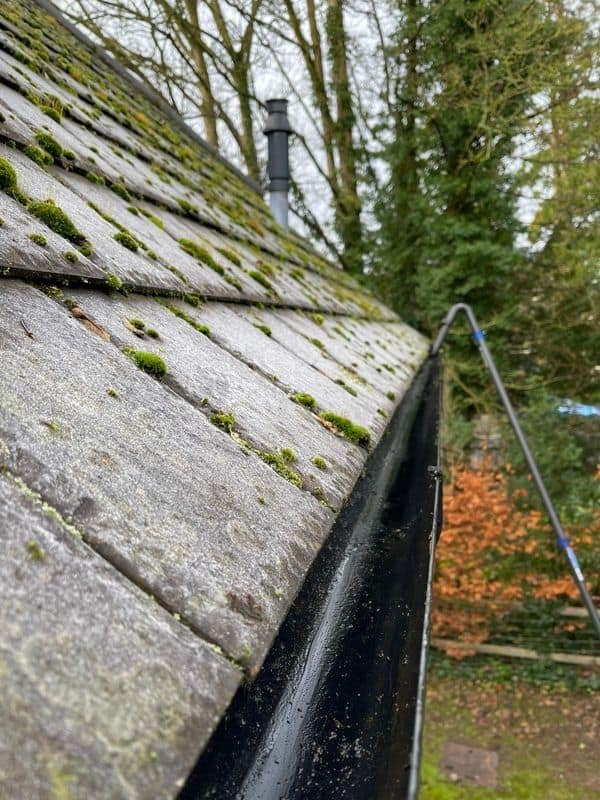
Commercial gutters should be cleared at least once a year after the main leaf fall (late October to December), and twice a year where the building is near trees.
At least once a year, after the main leaf fall
Late October to December. This matters most this year.
Twice a year for buildings near trees
Once after leaf fall, once in spring.
After a named storm
Check the outlets and hoppers. Storms bring down a lot of debris at once.
Before a cold snap
If water is standing in the gutters, so it can’t freeze in place.
What does a professional gutter clear include?
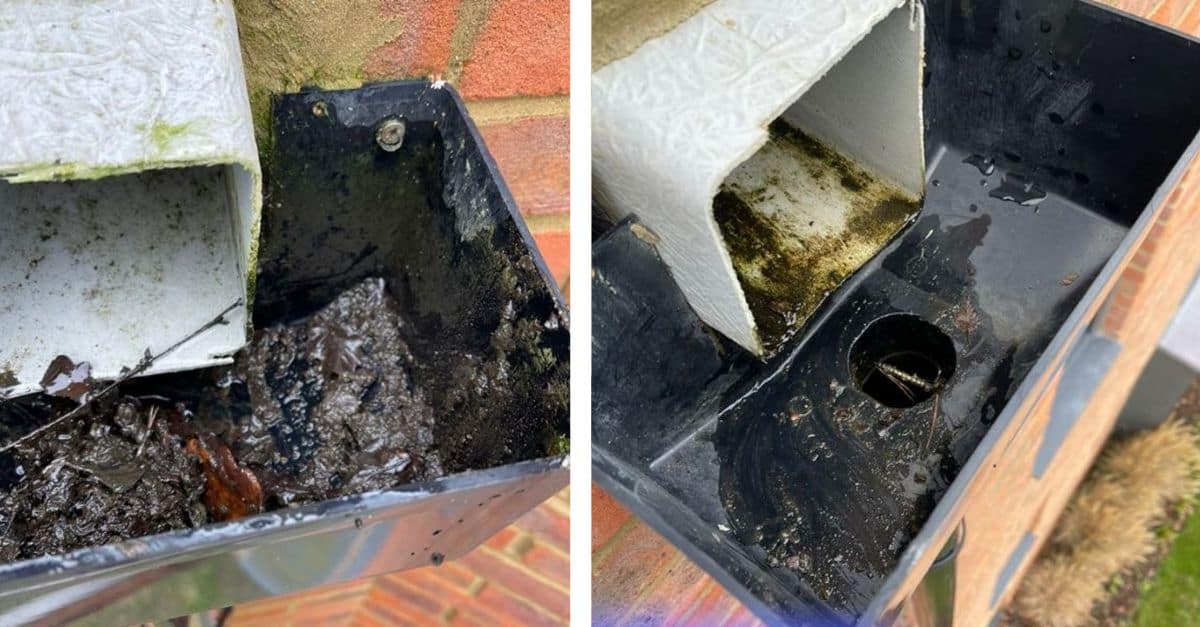
A professional gutter clear removes debris from the gutters, outlets and hoppers, flushes the downpipes, and gives you before and after photos with a note of any repairs needed.
- Safe access to the roofline (ladders, poles, or high-level access where needed)
- Debris removed from the gutter runs, outlets and hoppers
- Downpipes checked and flushed so water runs through
- Before and after photos
- Anything that needs a repair (a cracked joint, a loose bracket) noted for you, rather than hidden
Frequently asked questions
Can gutters be cleaned in winter?
Yes. Gutters can be cleared through winter in dry spells. The aim is to clear them before the heaviest rain and any freeze, not to wait for spring.
How often should commercial gutters be cleaned?
At least once a year after leaf fall, and twice a year where buildings sit near trees.
Do blocked gutters cause damp?
Yes. Overflow keeps external walls wet, and that moisture can come through as damp and mould on inside walls.
Can frozen gutters damage a building?
Water standing in a blocked gutter adds weight, and ice adds more. It can loosen brackets and crack joints, and meltwater then overflows onto walls and paths.
Who should check our gutters?
A specialist with safe access to the roofline, who checks the downpipes as well as the gutter run.
Would you like your gutters cleared before winter?
If we already clean your windows, ask for a combined price: gutters first, then windows, on one visit, with a report on anything that needs fixing.
About Walkers
Walkers Cleaning & Support Services is a family business that has grown into a national specialist cleaning provider since 1960. We are self-delivered and cover the whole of the UK, which means that wherever you are, our own crews clean windows, gutters and building exteriors for schools, housing providers and commercial buildings.